

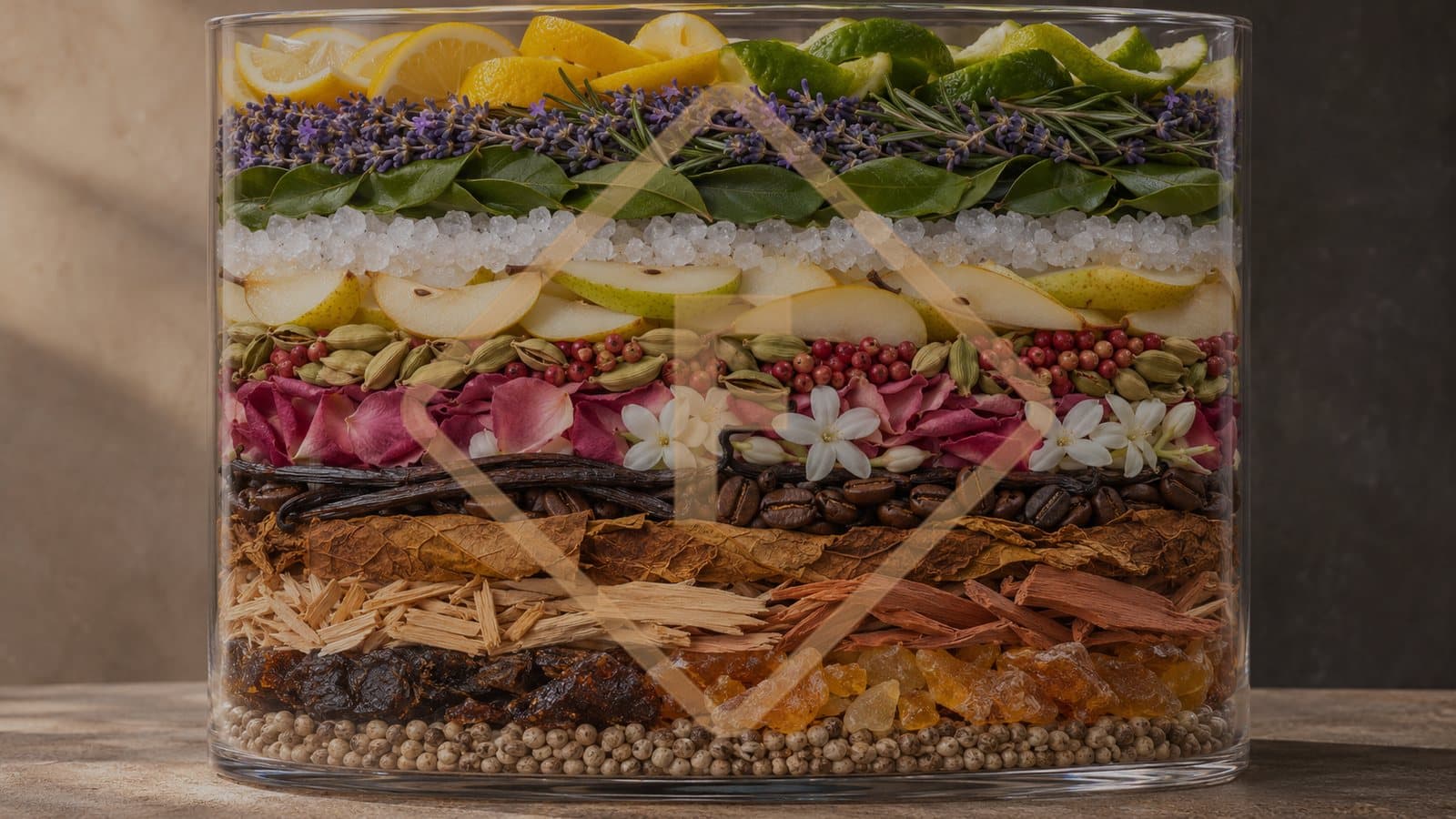
A fragrance note is the name given to a specific impression you can pick out in a scent: lemon, rose, cedar or leather, for example. A note is a descriptive word, not a promise about ingredients. Seeing lemon on a list does not prove the bottle contains lemon peel oil; the same impression can be built with lemon oil, with other citrus oils or with a combination of a few aroma molecules. The most useful question is therefore not "what is in it?" but "what do I smell here, and when do I smell it?"
This page explains the word from three angles: what it names, how it changes over time and which family it belongs to. The core diagram below arranges 13 families from the most volatile to the most lasting. Choose a moment to see which layers tend to come forward, and tap a layer to reach the notes of that family. The rest of the article explains why the diagram is a reading tool and not a fixed rule.
Where do 13 families stand in time?
A core is a sample column that shows layers of ground. Here the most volatile families sit on top and the most lasting at the bottom. Choose a moment and the layers in front change. Tap a layer to open it.
More volatile
A bright, tart, peel-like opening. Small terpenes evaporate quickly, so these notes are usually clearest in the first minutes.
Citrus Notes: all 12 notesA herbal character with a camphoraceous coolness. Examples such as lavender can read as floral at the same time.
Aromatic Notes: all 17 notesThe impression of snapped stems, leaves and grass. Some are resinous and bitter, others a juicy or milky green.
Green Notes: all 7 notesEvokes water, sea air and mineral coolness. Most come from a constructed scent idea and not from a single material.
Aquatic Notes: all 4 notesAdds a juicy, sweetish liveliness. The fruit impression is usually built from esters and lactones, not from a fruit extract.
Fruity Notes: all 23 notesWorks in two directions: cool and bright like pink pepper and cardamom, warm and dense like cinnamon and clove.
Spicy Notes: all 12 notesA wide territory and not one smell: it can be fresh, fruity, powdery or dark. It is often identified with a perfume's heart.
Floral Notes: all 36 notesNot a separate scent direction but a group known by the names of individual molecules. Their place in time varies with the molecule.
Modern Aroma Molecules: all 8 notesCarries food associations into the language of scent: vanilla, tonka, coffee. Smelling sweet does not mean a formula is sugary.
Gourmand Notes: all 24 notesCarries smoky, dry and slightly animalic impressions. Most are accords that have to be built, because they cannot be distilled directly.
Leather & Tobacco Notes: all 5 notesCan be dry, creamy or smoky. This family often carries the body and persistence of a perfume.
Woody Notes: all 21 notesWarm, balsamic and dense. The word amber usually names a warm accord built with resins and not a tree.
Amber & Resin Notes: all 14 notesLeaves a clean, skin-like, soft trace. Most of today's musk impression is built with synthetic molecules.
Musk Notes: all 5 notes
More lasting
Opening: Citrus Notes, Aromatic Notes, Green Notes, Aquatic Notes, Fruity Notes, Spicy Notes tend to come forward.
The diagram shows a typical tendency; it is not measured or formula data. Dose and neighbouring materials can change the order.
View as a table
| Family | Time | Example notes |
|---|---|---|
| Citrus Notes | Opening: In front · Heart: Alongside · Drydown: Behind | Lemon, Bergamot, Grapefruit |
| Aromatic Notes | Opening: In front · Heart: Alongside · Drydown: Behind | Lavender, Rosemary, Sage |
| Green Notes | Opening: In front · Heart: Alongside · Drydown: Behind | Galbanum, Cut grass, Fig leaf |
| Aquatic Notes | Opening: In front · Heart: Alongside · Drydown: Alongside | Marine notes, Ozone, Salt |
| Fruity Notes | Opening: In front · Heart: In front · Drydown: Behind | Pear, Peach, Blackcurrant |
| Spicy Notes | Opening: In front · Heart: In front · Drydown: Alongside | Pink pepper, Cardamom, Saffron |
| Floral Notes | Opening: Alongside · Heart: In front · Drydown: Alongside | Rose, Jasmine, Iris |
| Modern Aroma Molecules | Depends on the molecule | Aldehydes, Iso E Super, Ambroxan |
| Gourmand Notes | Opening: Behind · Heart: Alongside · Drydown: In front | Vanilla, Tonka, Coffee |
| Leather & Tobacco Notes | Opening: Behind · Heart: Alongside · Drydown: In front | Leather, Suede, Birch tar |
| Woody Notes | Opening: Behind · Heart: Alongside · Drydown: In front | Cedar, Sandalwood, Vetiver |
| Amber & Resin Notes | Opening: Behind · Heart: Alongside · Drydown: In front | Labdanum, Benzoin, Incense |
| Musk Notes | Opening: Behind · Heart: Alongside · Drydown: In front | White musk, Ambrette, Cashmere wood |
Note, raw material and molecule: three different words
These three words are often used interchangeably, yet they work at different levels. A raw material is the physical input used in production: an oil from bergamot peel, a rose absolute or a pure aroma chemical made in a laboratory. A molecule is the chemical unit that contributes to the smell. A note is the name we give to the whole impression the nose meets. One raw material contains many molecules, and one note can be built from several raw materials.
A few examples make the difference concrete. A rose note can be built with rose oil, but rose oil itself is not one smell; components such as citronellol, geraniol and damascenone, which is present at a very low level, shape its character together. Lily of the valley is a different case: because the flower yields no commercial perfumery extract, its impression has to be constructed from several materials. A peach note in most formulas comes not from the fruit but from lactones such as gamma-undecalactone. A sandalwood impression can come from real sandalwood oil or from synthetic molecules such as Javanol.
The word "natural" should not be treated as a measure of quality on its own. The composition of a natural oil can vary with the harvest, the source and the processing, whereas a synthesised molecule can deliver a more consistent effect from batch to batch. Safety, effect and aesthetic value are assessed separately from a material's origin. In modern perfumery the two usually work side by side.
A note list is not an ingredient list
The ingredients panel on the box and the note pyramid a brand describes are different documents. Under European Union cosmetics rules, the fragrance mixture may appear in the ingredient list under the word "parfum", while specified fragrance allergens above set thresholds are named separately. EU Regulation 2023/1545 extended that allergen list. So the official ingredient list does not hand you the formula, and a note pyramid is not an official declaration of contents.
A note pyramid is usually the brand's way of describing the scent. That does not make it worthless; it only means you should know what it is for. Finding different notes for the same perfume in different sources does not mean one of them must be wrong. People can describe a similar mixture in different words. What one list calls sea salt may read to you as mineral and to someone else as clean skin. Read the list as a map of expected scent directions, not as a laboratory report.
Top, heart and base notes: how to read time
The terms top, heart and base describe the dominant impressions of a scent over time. Materials that move quickly into the air are easiest to notice at the opening; other aspects emerge in the middle; the traces perceived for longest remain at the base. The 2022 review by Kleoff, Kiler and Heretsch explains this conventional division through volatility and persistence. The small terpenes in citrus oils evaporate quickly, while heavy musk molecules and resins can be followed for hours.
Even so, these three layers are not boxes that open one after another. The scent you smell at the opening already contains base materials; the more volatile components simply stand in front at that moment. Over time the proportion moving from the mixture into the air changes, and other impressions take over. That is why giving exact minutes is misleading. A top note that lasts a long time need not be a formula error, because the perfumer may have extended it with supporting materials. In perfumes described as linear, the pyramid is barely felt at all.
The diagram above shows this tendency at family level and is not measured data. A floral note can shine in the opening of some formulas, and some woody materials can be noticeable from the first minute. Use the diagram as the start of a first guess rather than as a rule, then test that guess on your skin with your own observation.
Accords: where one note is not enough
An accord is an arrangement of several materials that together are perceived as one scent idea. Leather, sea air and rain cannot be distilled directly; these impressions can only be built. A leather note is often an arrangement of the smokiness of birch tar, the dry harshness of quinolines and soft base materials. A marine note took on its familiar modern form through molecules such as Calone, which became widespread in the late twentieth century.
The line between a note and an accord is not always visible on a list, because both can be written with the same word. When you read amber, cashmere or clean skin, do not interpret them as the name of a single plant. You can find more examples in the accord articles. The 2014 review by Thomas-Danguin and colleagues sheds light on why mixtures behave this way: the nose sometimes separates a mixture into parts and sometimes perceives it as one new odour object.
Why do people smell the same note differently?
When two people name different notes in the same perfume, this is often not an error to be settled. First, there can be a biological difference. The 2007 study by Keller and colleagues shows that genetic variation in a single odorant receptor can change the perception of a molecule such as androstenone. The same molecule can be described in markedly different ways by different people.
Second, the nose adapts. The 2017 review by Pellegrino and colleagues describes how odour perception declines with continued exposure. Failing to notice your perfume after a while does not mean it has entirely gone. For the same reason, smelling many scents in a row makes it harder to judge the later ones fairly.
Third, there is language. Naming smells is hard, and Olofsson and Gottfried discuss the neuroscientific reasons for this limitation. Yet it is not a universal shortcoming: Majid and Burenhult report that speakers of Jahai, a language of the Malay Peninsula, name odours as consistently as colours. Scent words are in large part learned. Not recognising a note may show that you have not yet tied that word to a smell, not that your nose is weak.
The thirteen note families
A family is not a class of molecules but a practical name for similar perceptual qualities. The borders are porous: ginger can read as both fresh and spicy, and lavender as both floral and aromatic. At Fragrans we place each note in the one family where it is most often read, while tags keep showing its other sides. A family does not describe a whole perfume either. It only makes the first sorting easier.
Citrus
Citrus notes give a bright, tart and peel-like opening. Lemon is sharp, bergamot more floral and green, and grapefruit slightly bitter. Because they are volatile, they are usually clearest in the first minutes.
Aromatic
Aromatic notes are known for a herbal character with a camphoraceous coolness. Lavender, rosemary and sage are familiar examples. Lavender can also read as floral, while rosemary tends to feel sharper.
Green
Green notes suggest snapped stems, leaves and grass. Galbanum carries a resinous bitterness, cut grass a lively wetness and fig leaf a milky greenness.
Aquatic
Aquatic notes evoke water, sea air and mineral coolness. Marine notes, ozone and salt mostly come from a constructed idea and not from one material. Their persistence therefore cannot be predicted from the family name.
Fruity
Fruity notes add a juicy, sweetish liveliness. Pear can be fresh, peach velvety and blackcurrant sharp and greenish. The fruit impression is usually built from esters and lactones and not from a fruit extract.
Spicy
Spicy notes work in two different directions. Pink pepper and cardamom give the opening a cool, bright movement, while cinnamon and clove feel warmer and denser. Saffron can stand where leather and honey meet.
Floral
Floral notes are a wide territory and not one smell. Rose can be fruity or spicy, jasmine dark and fruity, and iris powdery and rooty. This family is often identified with the heart of a perfume, yet it can appear in the opening and the base too.
Modern aroma molecules
Modern aroma molecules are not a separate scent direction but a group known by the names of individual molecules. Aldehydes can give a bright, waxy opening, Iso E Super a soft woodiness and Ambroxan a mineral, amber-like trace. Their place in time varies with the molecule.
Gourmand
Gourmand notes carry food associations into the language of scent. Vanilla can be warm and soft, tonka hay-like and almondy, and coffee roasted and dry. Smelling sweet does not mean a formula is sugary.
Leather and tobacco
Leather and tobacco notes carry smoky, dry and slightly animalic impressions. Leather can be hard, suede soft and birch tar distinctly sooty. Most of them are accords built for that effect.
Woody
Woody notes can be dry, creamy or smoky. Cedar has a pencil-shaving dryness, sandalwood a milky softness and vetiver a rooty, earthy depth. This family often carries the body and persistence of a perfume.
Amber and resin
Amber and resin notes are warm, balsamic and dense. Labdanum, benzoin and incense rest on a real tradition of resins. The word amber, however, usually names a warm accord built with such materials and not a tree.
Musk
Musk notes leave a clean, skin-like and soft trace. White musk carries a soapy idea of cleanliness, while ambrette has a pear-like softness that comes from a seed. Most of today's musk impression is built with synthetic molecules. It is also a known phenomenon that some people barely perceive certain musks.
Names that are often confused
Amber, ambergris and fossil amber are not the same thing. In perfumery, amber mostly describes an accord leaning on labdanum, benzoin and vanilla; ambergris is a separate material from the sperm whale, and its impression today is often given by molecules such as Ambroxan. Musk is a similar case: its traditional name points to an animal source, yet the musk effect in today's perfumes is largely synthetic.
Oud is not one smell either. Materials obtained from the resinous wood that forms when the agar tree responds to infection vary widely by source and processing, and many perfumes contain only an accord giving an oud impression. Names such as clean, cashmere or ocean also name a tactile association more than a material. These are not arbitrary words, but looking for a concrete plant behind them will mislead you.
How should you read a note list?
First count the families on the list: which direction does the majority point towards? Then consider what the notes say together. The trio of lemon, lavender and cedar is not enough to conclude that a perfume is fresh; how long the lemon lasts, whether the lavender is soapy or herbal and whether the cedar stays dry or turns creamy all decide the result. Do not decide from one note you love. A favourite material can turn into something else in an unexpected arrangement.
Then think about time. A list with many top notes can give a lively first impression, but the base notes are what remain a few hours later. That is why basing a purchase on the first ten minutes is misleading. Finally, compare the list with your own notes: write down the scent in your own words first and look at the official list afterwards. This also reduces the chance that a word you saw first will steer what you perceive.
How do you learn a note with your own nose?
Comparison is the fastest route. If possible, smell the material alone; if not, put two or three different perfumes where that note is prominent side by side. With lemon, for example, try to separate the associations of peel, juice and sugary lemonade; with rose, the sides of fresh leaf, jam and powder. This comparison shows that a note sharing one name has no single fixed smell.
When taking notes, do not stop at "liked it" or "did not like it". Write down intensity, timing and the smells that accompany it. An observation such as "sharp lemon for the first five minutes, then soft flower, then dry wood a few hours later" builds your own scent vocabulary. Try only a few scents in one session and take a break when your nose tires. Check on paper and on skin separately, because the two results may differ.
Four common mistakes when reading notes
The first mistake is treating a note name as a measure of quality. Seeing names with costly associations such as oud, iris or neroli says nothing about how much of those materials a formula uses or at what grade. In the same way, a short, plain note list does not show that a scent is simple. A brand may simply have chosen to highlight a few impressions. The way to assess a perfume is not to weigh the list by its length but to follow how the scent changes on skin.
The second mistake is reading a family as information about the wearer or the season. A floral note does not mean feminine and a woody note does not mean masculine; those divisions come more from marketing habits than from the smell itself. Vanilla does not belong to winter, nor citrus to summer. That a dense scent can feel more dominant in hot weather may be a real observation, but it is not a firm rule you can draw from a family name. Consider intensity and setting separately when you decide.
The third mistake is drawing a general conclusion from one experience. Saying "I do not like rose" often means disliking one interpretation of rose, such as a soapy or powdery arrangement. A fruity rose, a dark spicy rose and a rose with fresh green leaves can smell very different. Before you rule out a note you think you dislike, try it beside another family. At the right dose and with the right neighbours, the same material can have an effect you did not expect.
The fourth mistake is using a note list as health information. Oakmoss being absent from a list does not show that a formula contains no allergens, and a note being listed does not prove the material is present. If you have a sensitivity or a known allergy, look at the ingredients panel on the box and not at the note pyramid, and make the decision with a health professional. A note is a useful word for understanding a scent; it does not replace a safety declaration.
How should you use this section?
Start with a family you recognise and then move to a neighbouring one. If you like citrus, the green or aromatic family is a sensible next step; if you like vanilla, the amber or musk family is. Each family page gathers the notes of that group in one place, and each note page explains where the smell comes from, how it is built and within what limits it should be read. You can then follow the layers of time in the anatomy of perfume guide.
The aim of this section is not to hand out scores but to make the words we use clear and testable. Read the definition first, smell an example next and then write down your own observation. Together, those three steps give a more reliable understanding than a note pyramid alone.
Sources
Kleoff, Kiler and Heretsch (2022), Synthesis of odorants in flow and their applications in perfumery, Beilstein Journal of Organic Chemistry.
Thomas-Danguin and colleagues (2014), The perception of odor objects in everyday life, Frontiers in Psychology.
Keller and colleagues (2007), Genetic variation in a human odorant receptor alters odour perception, Nature.
Pellegrino and colleagues (2017), Habituation and adaptation to odors in humans, Physiology & Behavior.
Olofsson and Gottfried (2015), The muted sense, Trends in Cognitive Sciences.
Majid and Burenhult (2014), Odors are expressible in language, as long as you speak the right language, Cognition.
European Commission, Regulation (EU) 2023/1545, on the labelling of fragrance allergens.


